How to Look Like a Math Whiz

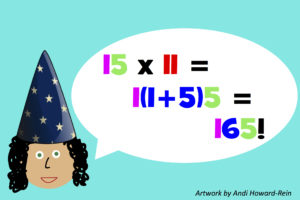
Numbers are very regular and make beautiful patterns, and if you know those patterns, you can do some pretty cool tricks. Some tricks let you add and multiply big numbers in your head. It’s easy to multiply a big number by 11, and to square numbers ending in 5 (to square a number means to multiply it by itself). As this video on vedic math shows, you can even multiply big numbers by other big numbers in your head. Today we’ll show you some of the coolest number tricks out there, so you can wow your family and friends!

Wee ones: A fun trick is to figure out whether you can cut a number into 3 equal pieces (called dividing). If its digits add up to something divisible by 3, then the original number is divisible, too! Is 141 divisible by 3?

Little kids: To multiply a 2-digit number by 11, you just add its two digits and stick the answer in between the 2 digits. So for example, 32 times 11 is 352 (because 3+2=5). Quick, can you multiply 43 x 11?  Bonus: To multiply a big number by 5, you cut it in half and tack on a zero. Quick, what’s 24 x 5?

Big kids: That works in the opposite direction, too: to divide by 5, you chop a zero off and then double what’s left. Quick, what’s 620 divided by 5?  Bonus: To get the square of any 2-digit number that ends in 5, you take the first digit, multiply it by the next digit up, and then tack on 25 to the end. So for example, 35×35 is 1225, because 3×4=12, and then you tack on 25. Quick, what’s 55×55?


Answers:
Wee ones: Yes, because 1+4+1=6, and if you hold up 6 fingers, you see that you can group them into sets of 3.

Little kids: 473.  Bonus: 120, because half of 24 is 12.

Big kids: 124, since that’s 62 x 2. A great way to figure out the tip at restaurants.  Bonus: 3025, since 5 x 6 is 30, then tack on a 25.

And a big thank-you to Talie B. for sharing that video!

Print Friendly

Flipping Coins with Mickey

You probably think toys today are really cool compared to the bummer ones your parents must have had. Well, even though your parents lived in caves and ate dirt for dinner, we all had some cool toys ourselves – like the Mickey Mouse coin sorter, shown here. This toy hails from decades ago, or at least that’s when I got mine (let’s not focus on which decade…), and is both piggy bank and marvel of machinery. When you stick a coin into the slot at the top right, if it’s a quarter it’s heavy enough to tip the first red seesaw and fall into Mickey’s right arm. If it’s a nickel, it shoots straight through to his left arm. Pennies and dimes are narrower so they fall through a hole in that seesaw, then either tip or shoot through the bottom seesaw into the correct leg. So smart and simple, all without batteries, lasers or digital screens. Even without electricity or blinking lights, the money still adds up.

Wee ones: If you stick 2 quarters, 3 dimes, 2 nickels and a penny into Mickey, how many coins did you sort?

Little kids: If Mickey has 4 coins in each arm and 4 coins in each leg – 4 quarters, 4 dimes, 4 nickels, 4 pennies – how many coins is he holding?  Bonus: How many seesaw tips did those coins make happen? (Again, quarters and pennies each tip one seesaw; dimes and nickels shoot through.)

Big kids: If you put 5 of each type of coin into Mickey, how much money is that, in cents?  Bonus: If you swap out all the pennies and replace them with 5 extra quarters, now how much money do you have?

The sky’s the limit: If you put in 82 cents and exactly 4 seesaw tips happened, how many combination of coins could you have put in?


Answers:
Wee ones: 8 coins.

Little kids: 16 coins.  Bonus: 8 tips.

Big kids: 205 cents or $2.05, since it’s 5 times 41 cents.  Bonus: $3.25.

The sky’s the limit: 4 possibilities. You had to have put in 2 quarters (one tip each) plus 2 pennies for 2 more tips, so nickels or dimes make up the remaining 30 cents. Possible combinations are 3 dimes 0 nickels, 2 dimes 2 nickels, 1 dime 4 nickels, and 0 dimes 6 nickels, always with 2 quarters and 2 pennies.

Print Friendly

Behind Bars

Have you ever looked at a toy, book, or box of cereal and noticed a little rectangle of black stripes,  with little numbers under it? That’s called a bar code, and that symbol tells the scanner at the store which thing you’re buying, so the store can charge you. Every item has to have its own number so prices don’t get mixed up. And each digit has its own combo of 2 or 3 thin and thick bars, which the scanner can see and count up. Now there are QR codes which show a square full of teenier squares, and smartphones can snap a photo of them. But stripey ones really set the bar.

Wee ones:  If a bar code has 5 numbers in the first half and 5 in the second half, how many numbers does it have in total?

Little kids: If the digit 8 is shown using 2 fat bars and a 3 uses 1 fat bar and 1 thin, how many bars does the code 33333 88888 have?  Bonus: If a 4 needs 3 bars, how many bars for the code 43434 34343?

Big kids: If an 8 uses 2 fat bars and a 9 uses 1 fat and 2 thin, how many 8s are there in a code with 12 thin bars and 14 fat ones, if the code contains only 8s and 9s?  Bonus: What if the same bar code has 4 0s in the mix, where each 0 uses 2 thin bars – now how many 8s?

The sky’s the limit: If 10-digit codes can run from 00000 00000 to 99999 99999, how many codes have only odd digits for the first 5 digits?

Answers:
Wee ones: 10 digits total.

Little kids:  20 stripes, since it uses 10 digits each using 2 stripes.  Bonus: Now you have 25 stripes.

Big kids: There are enough thin bars for 6 9s, which use up 6 fat bars.  That leaves only 8 fat bars for 4 8s.  Bonus: The 0s use up 8 thin bars, leaving only 4 unclaimed thin ones, so now there are only 2 9s. That now leaves 12 fat bars for 6 8s.

The sky’s the limit: An odd first digit knocks out half the codes, and the next knocks out half of the remaining codes, and so on.  So only 1/32 of the 10,000,000,000 codes are possible.  That cuts you to 5 billion, then 2.5 billion, then 1.25 billion, then 625 million, then 312.5 million, or 312,500,000.  The other approach is that the first odd digit enables 5 families of codes, times 5 for each digit that follows…giving you 5x5x5x5x5x10x10x10x10x10.

Print Friendly

Mirror Image

It’s very cool that some letters and numbers look the same when we flip them upside-down. An 8 is a great example of that, as is a capital H. But other letters get a little more complicated, since there are two ways to flip them upside-down, and sometimes they will look the same only if you flip the correct way. Some letters and numbers have mirror symmetry: if you stand them up on a mirror, they basically look the same upside-down on the mirror as they do standing up. A capital B or E works that way. But the letter N doesn’t – it will look backwards. That’s because letters like N have rotational symmetry: if you spin them around so they’re upside down, they look the same. That won’t work on a B or E, as this time they’ll look backwards. The letter H will look right either way since it has both kinds of symmetry.  Check out the alphabet, and see how many words you can write that work either way.

Wee ones: Can the letter S look the same upside down? Which way do you have to flip it?

Little kids: If you write your name in all capitals and stand it on a mirror, how many of the letters will still look correct?  Bonus: How about if you spin your name halfway around on a piece of paper? Now how many letters still look right?

Big kids: Which uppercase letters of the alphabet look the same either flipped or spun upside down?  Bonus: How many letters in the alphabet look the same standing on their mirror image?


Answers:
Wee ones: Yes, if you spin it around. Standing the S on a mirror won’t work!

Little kids: Different for everyone…see if you can figure it out without a mirror!  Bonus: Different for everyone again.

Big kids: Not many…by our count there are only 4 of them: H, I, O, and X.  Bonus: All of those, plus B, C, D, E, and K (if written a certain way).

Print Friendly

Give Me a Sign

Billboards are those big rectangular signs along the side of the highway, usually trying to talk you into buying something.  Since they’re a good 50 feet above you, these signs are even bigger than they look – they’re 20, 30, or even over 40 feet wide. The size depends on the speed of the traffic: the faster you’re driving, the easier it has to be for people to read it, so the bigger the letters and pictures need to be. The signs along slower streets in town, called “posters,” are 22 feet wide, but the big “bulletins” along the highway are up to 48 feet wide. Now we have digital billboards that light up like a computer screen and change the picture every few seconds, showing drivers even more things they should buy. Either one works, as long as we read it quickly: the more important thing as a driver is to keep your eyes on the road.

Wee ones: Which one is wider, a 20-foot-wide poster or a 40-foot-wide billboard?

Little kids: If a billboard is 10 feet tall and the bottom is 50 feet off the ground, how many more of those same signs could you stack edge to edge below it?  Bonus: If you want to climb up to that 50-foot sign but all you have is an 8-foot ladder, how many more feet does your ladder have to reach?

Big kids: If an adult’s face is 9 inches tall, and all objects on a billboard are 12 times life size, how tall is a face shown on a billboard?  Bonus: These giant highway signs are about as big as a house. If the front of a house has a 15-foot-wide kitchen, a 6-foot-wide hallway, and an 18-foot-wide living room, which one is wider, the house or a 48-foot-wide highway billboard?

The sky’s the limit: Suppose as a prank you decide to climb up a billboard at night and wrap a string of lights around the edge. If you need exactly 82 feet of strung lights to cover all four sides, and the area of the billboard (length times width) is 400, what are the width and height of the billboard?


Answers:
Wee ones: The billboard is the bigger number.

Little kids: 5 more of those signs.  Bonus: 42 more feet.

Big kids: 108 inches, or 9 feet!  Bonus: The billboard would be wider if leaned up against the house – 48 feet vs. 39.

The sky’s the limit: It’s 25 by 16 feet. We know that the width and height have to add to 41, since those two sides will use up half the lights. Those same two numbers also multiply out to 400. You can use trial and error to test the factors of 400 numbers: 40 by 10 doesn’t work, nor does 20 by 20, but 16 by 25 does. Expressing this using algebra:
w + h = 41, so h=41-w
w x h = 400. Replacing h, you get
w x (41-w)=400
41w – w^2=400, or w^2-41w+400=0
…and then you still need trial and error to break it down into
(w-25) x (w-16)=0.  So w=16 or 25.

Print Friendly